
FOB, CNF, AND CIF WHEN IMPORTING SPICES FROM VIETNAM: HOW TO CHOOSE THE RIGHT SHIPPING TERM AND COMPARE QUOTATIONS
The same spice shipment can come with significantly different quotations under FOB, CNF, or CIF terms. This is because each Incoterm allocates different responsibilities for vessel booking, ocean freight payment, cargo insurance, and the point at which risk transfers from the seller to the buyer.
For importers sourcing black pepper, cinnamon, star anise, dried ginger, turmeric, or dried chili from Vietnam, understanding these terms helps them compare quotations more accurately, estimate transportation costs, and minimize disputes during cargo delivery and receipt.
This article explains the differences between FOB, CNF, and CIF under Incoterms 2020, key considerations when importing containerized spices, and how to convert quotations to identify the most suitable option.
FOB, CNF, and CIF: Three Common Shipping Terms
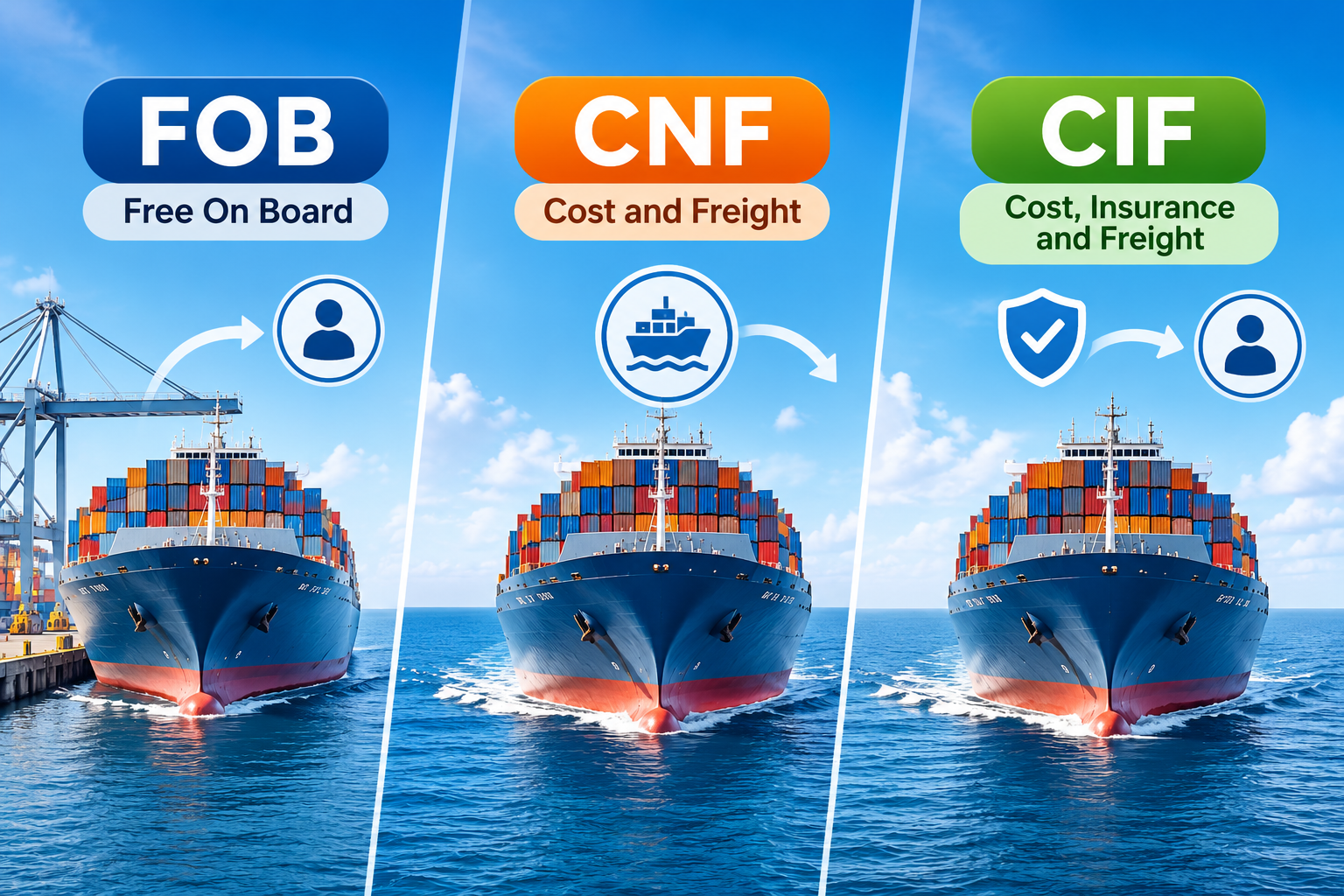
FOB, CNF, and CIF are three terms within the rules for sea and inland waterway transport under Incoterms 2020, issued by the International Chamber of Commerce (ICC).
A common feature of all three terms is that the seller fulfills the delivery obligation and transfers the risk once the goods have been loaded on board the vessel at the port of shipment. The main differences concern which party is responsible for arranging and paying for international freight, as well as the obligation to obtain cargo insurance.
What Is FOB?
Under FOB (Free On Board), the seller is responsible for preparing the goods, completing export customs formalities, and delivering the cargo on board the vessel at the agreed port of loading.
Once the goods have been loaded on board, the risk transfers to the buyer. The buyer is responsible for booking the vessel, paying ocean freight, arranging insurance if necessary, and completing import procedures in the destination country.
For example, under a quotation of FOB Hai Phong, Incoterms 2020, the Vietnamese exporter is responsible for loading the spice shipment onto the vessel at Hai Phong Port. The importer arranges transportation from Hai Phong to the destination port.
FOB is suitable when:
-
The importer has an existing contract with a shipping line or freight forwarder.
-
The business wants to control the shipping route, vessel schedule, and freight rates.
-
The buyer has the capability to manage international transportation costs and insurance.
What Is CNF?
The terms CNF or C&F are commonly used in commercial transactions to indicate that a quotation includes freight costs. However, the official term under Incoterms 2020 is CFR (Cost and Freight).
Under this term, the seller is responsible for loading the goods on board the vessel at the port of shipment, completing export procedures, and paying the freight costs to the named destination port.
The buyer does not need to book the vessel directly or pay the ocean freight for the main transportation leg. However, the risk still transfers to the buyer as soon as the goods are loaded on board at the port of shipment. The buyer must also arrange cargo insurance independently if required.
For example, a quotation of CNF Mumbai, Incoterms 2020 includes the freight cost from a Vietnamese port of shipment to Mumbai Port, but does not require the seller to purchase cargo insurance.
CNF is suitable when:
-
The importer wants a quotation that already includes ocean freight.
-
The seller can arrange transportation at a competitive freight rate.
-
The buyer prefers to choose their own insurance provider or already has a separate insurance policy.
What Is CIF?
CIF (Cost, Insurance and Freight) has similar responsibilities to CNF, but the seller must also arrange and pay for cargo insurance covering the shipment to the named destination port.
Under Incoterms 2020, the minimum insurance coverage required under CIF must amount to 110% of the contract value. This is basic insurance coverage and does not mean that every possible transportation risk is insured. If broader protection is required, the importer should discuss this with the seller and carefully review the insurance documents.
Another important point is that although the seller pays for freight and purchases insurance, the risk still transfers to the buyer once the goods are loaded on board the vessel at the port of shipment.
CIF is suitable when:
-
The importer wants the seller to arrange both ocean freight and basic cargo insurance.
-
The business wants to simplify the organization of international transportation.
-
Both parties have clearly agreed on the insurance coverage and required documentation.
Comparison of FOB, CNF, and CIF
| Criteria | FOB | CNF (CFR) | CIF |
|---|---|---|---|
| Vessel booking | Buyer | Seller | Seller |
| Ocean freight payment | Buyer | Seller | Seller |
| Cargo insurance | At the buyer’s discretion | At the buyer’s discretion | Seller purchases minimum required coverage |
| Export procedures | Seller | Seller | Seller |
| Import procedures | Buyer | Buyer | Buyer |
| Transfer of risk | When goods are loaded on board at the port of shipment | When goods are loaded on board at the port of shipment | When goods are loaded on board at the port of shipment |
Therefore, importers should not assume that CNF or CIF means the seller remains responsible for the goods until they arrive at the destination port. The seller pays the freight to the destination port, but transportation risk transfers to the buyer at the port of shipment.
Should You Choose FOB, CNF, or CIF When Importing Spices from Vietnam?
No single shipping term is always more advantageous in every situation. The right choice depends on the buyer’s ability to arrange transportation, the import route, the destination port, and how the business wants to manage its costs.
Choose FOB if You Want to Control Transportation
If your business already has a freight forwarder in Vietnam or a transportation contract with a shipping line, FOB may be a suitable option. The importer can directly manage ocean freight costs, vessel schedules, and transportation arrangements according to its own plans.
This is particularly useful for businesses that regularly import large volumes of spices or handle multiple shipments from different suppliers.
Choose CNF if You Want a Quotation That Includes Ocean Freight
CNF means the importer does not need to arrange international transportation directly for each shipment. The seller organizes ocean freight to the destination port, while the buyer retains the freedom to decide whether to purchase cargo insurance.
This option is worth considering when the exporter can secure competitive freight rates or has experience arranging transportation along the route used by the buyer.
Choose CIF if You Want the Seller to Arrange Insurance as Well
CIF is suitable when the importer wants a quotation that includes ocean freight and basic cargo insurance. However, this does not mean that every possible transportation risk is covered. If the spice shipment has a high value or the transportation route involves significant risks, the buyer may request broader insurance coverage than the CIF minimum requirement.

How to Calculate FOB, CNF, and CIF Prices When Importing Spices
One reason importers may find it difficult to compare quotations is that suppliers can offer prices under different shipping terms.
In principle, the relationship between these three price levels can be illustrated as follows:
CNF Price = FOB Price + Ocean Freight
CIF Price = CNF Price + Cargo Insurance Premium
For example, suppose a shipment of black pepper is quoted at an FOB price of USD 2,000 per ton. The ocean freight allocated to each ton is USD 150, and the insurance premium is USD 20 per ton.
| Item | Reference Price |
|---|---|
| FOB Price | USD 2,000/ton |
| Ocean Freight | USD 150/ton |
| CNF Price | USD 2,150/ton |
| Insurance Premium | USD 20/ton |
| CIF Price | USD 2,170/ton |
These figures are for illustrative purposes only and do not represent actual quotations. When calculating the CIF price, the insured amount must meet the minimum requirement of 110% of the contract value under Incoterms 2020.
In practice, converting between quotations may require additional costs or the allocation of expenses incurred at the port of shipment. Therefore, importers should ask suppliers to clearly itemize all costs included in their quotations rather than relying solely on the formulas for adding freight and insurance.
Comparing Quotations from Multiple Suppliers: Key Details to Clarify
To avoid choosing a supplier simply because their quoted price is lower, importers should compare quotations on the same basis:
-
Shipping terms: FOB, CNF, or CIF, with the port of loading and destination port clearly specified.
-
Product information: Spice type, product form, quality grade, and technical specifications such as moisture content, foreign matter, bulk density, or microbiological parameters, as required.
-
Order specifications: Quantity, packaging type, weight per bag, and container loading arrangements.
-
Transportation costs: Ocean freight, surcharges, and all costs included or excluded from the quotation.
-
Quotation validity: Validity period and the possibility of price adjustments when freight rates fluctuate.
In particular, importers should not compare an FOB quotation with a CIF quotation based solely on the total price. Both quotations should first be converted to the same shipping term and destination port before evaluation.

Import Documents for Spices Under FOB, CNF, and CIF
The required set of documents depends on the product, destination market, contractual terms, and requirements of the relevant authorities in the importing country. However, several documents are commonly required or considered by importers:
-
Commercial Invoice: States the value of the goods and the terms of the transaction.
-
Packing List: Specifies the number of packages, weight, and packaging details.
-
Bill of Lading (B/L): A sea transport document confirming receipt of the goods for shipment and providing relevant cargo information.
-
Certificate of Origin (C/O): Certifies the origin of the goods, if required or necessary to qualify for preferential tariffs.
-
Certificate of Analysis (COA): Provides test results for product quality parameters as agreed by both parties.
-
Phytosanitary Certificate: A plant health certificate required when applicable to the product and the regulations of the importing country.
-
Insurance Policy or Insurance Certificate: Cargo insurance documentation for CIF transactions.
Importers should agree on the list of required documents, the information to be stated in each document, and the submission timeline when confirming the contract.
Import Spices from Vietnam with Viet Linh Agrimex
Viet Linh Agrimex supplies Vietnamese spices, including pepper, cinnamon, star anise, ginger, and turmeric, with flexible product specifications to meet importers’ requirements.
Businesses can discuss product types, technical specifications, order quantities, packaging, and FOB, CNF, or CIF shipping terms to receive quotations that suit their import plans.
Contact Viet Linh Agrimex for support in finding a suitable import solution:
-
Phone/WhatsApp/Zalo: +84 345 128 188
-
Email: cskh@vietlinhagrimex.vn